

Gold and silver head into 2026 with historic momentum and rising structural risks


 Messenger
 Whatsapp
 Threads
 Email
Email
 Print
Print
 X
X
 Facebook
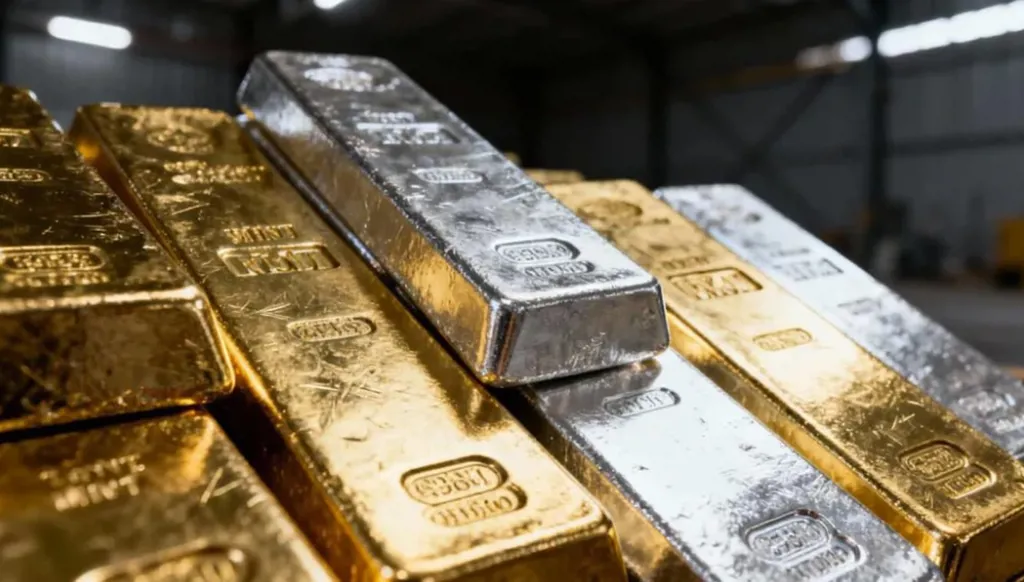


Precious metals enter 2026 with strong momentum following historic gains in 2025, when gold rose by more than 72% and silver by more than 174%, marking gold’s strongest annual performance in nearly 46 years.
These gains unfolded amid a highly volatile global environment marked by escalating geopolitical conflicts and mounting economic uncertainty, which strongly pushed investors toward safe-haven assets.
This exceptional performance was not limited to a single year. Since 2020, gold has outperformed the S&P 500, rising by more than 130% compared with nearly 85% for the U.S. index. This divergence clearly signals a structural shift in global portfolio behavior, highlighting the growing importance of hedging assets over higher-risk investments.
Lower U.S. interest rates, declining real bond yields, rising central bank purchases, and a strong return of gold ETF inflows all contributed to reinforcing this upward trend.
Silver, meanwhile, benefited from a surge in industrial demand linked to solar energy, batteries, and semiconductors. This has created a clear structural imbalance between supply and demand, pushing prices to unprecedented levels and laying the groundwork for continued positive momentum through 2026.
Rising prospects and a structural shift in metals’ role
Gold enters 2026 supported by a set of structural drivers that place it at the center of the global hedging landscape. Continuous central bank purchases have evolved into a permanent strategic support factor, rather than a cyclical one, particularly since the freezing of Russian assets in 2022 raised fundamental concerns about overreliance on the dollar as the sole reserve currency.
Central banks have accumulated more than 1,000 tons of gold annually over the past three years, compared with an average of about 600 tons over the previous decade, pointing to a reconfiguration of the global reserve system.
China stands out as a key player in this shift. The People’s Bank of China recorded 13 consecutive months of gold purchases through November 2025, increasing its holdings to more than 2,300 tons - over 8% of its total foreign exchange reserves.
This strategy is widely viewed as an effort to reduce dependence on the dollar and bolster the credibility of the yuan as a reserve currency backed by a stable, globally accepted physical asset.
Gold ETF inflows are expected to remain positive throughout 2026, supported by expectations of accommodative monetary policies and persistent global economic concerns. India recorded its highest historical inflows in 2025, opening the door for further growth in investment demand, alongside rising gold holdings in Europe and China, particularly amid weak local currencies.
U.S. monetary policy is also expected to continue supporting gold. Each decline in real yields lowers the opportunity cost of holding non-yielding assets, enhancing gold’s appeal. Additional drivers include persistent inflation concerns, expanding global public debt, and declining confidence in traditional monetary frameworks.
Geopolitical and trade factors add further support
Geopolitical tensions remain a key pillar supporting gold, from the conflict in the Middle East and the war in Ukraine to escalating trade and technological frictions between the United States and China. Frequent shifts in U.S. tariff policies and abrupt changes in trade direction have increased market volatility and weighed on the dollar, prompting investors to strengthen positions in safe-haven assets, particularly gold.
Economically, the likelihood of a global growth slowdown in 2026 - driven by weaker consumer spending, a cooling labor market, and pressure on corporate profits - reinforces institutional demand for gold as a portfolio stabilizer amid underperforming stocks and bonds.
Silver: Chinese restrictions and a deepening structural deficit
Silver enters 2026 in a more sensitive and complex phase, driven by a worsening structural supply deficit and China’s tightening grip on global supply chains. Beijing announced new restrictions on silver exports effective Jan. 1, 2026, imposing strict licensing conditions, including a minimum annual production of 80 tons and financial requirements of up to $30 million, effectively excluding small and medium exporters from global markets.
Given China’s control of roughly 60% to 70% of global silver supply, any export restriction has an immediate impact on international availability. Observers compare this policy to China’s earlier approach to rare earth minerals, where strict regulation allowed it to exert significant influence over global flows and reprice those commodities.
These developments come as the silver market records its fifth consecutive year of structural deficit. Global demand in 2025 reached about 1.24 billion ounces, while supply did not exceed 1.01 billion ounces, creating an annual gap of 100 to 250 million ounces as industrial demand continues to expand.
The imbalance is compounded by sharply declining inventories across major trading hubs. COMEX stocks have fallen by roughly 70% since 2020, London inventories by about 40%, and Shanghai’s reserves have dropped to their lowest levels in a decade. Some estimates suggest certain regions hold only 30 to 45 days of usable supply.
This scarcity is reflected in the widening gap between paper and physical silver markets. The ratio of paper contracts to deliverable metal has reached around 356 to 1, while buyers increasingly pay high premiums for physical delivery, particularly in Asian markets, with Shanghai prices signaling acute shortages.
On the supply side, mining remains unable to respond quickly. Most silver production is a byproduct of copper and zinc mining, limiting output flexibility. New mine development can take more than a decade due to declining ore grades, high costs, and environmental constraints, while recycling remains insufficient to close the supply gap.
Industrial demand now accounts for 50% to 60% of total silver consumption, driven by solar energy, electric vehicles, electronics, and medical equipment, with few viable substitutes, heightening the market’s sensitivity to supply disruptions.
Despite these strong supportive factors, the environment in 2026 is expected to be more volatile and complex. Diverging monetary policies, potential abrupt shifts in interest-rate paths, global trade disruptions, and geopolitical shocks could trigger sharp price swings. The growing disconnect between paper markets and physical metals also increases pricing and liquidity risks, particularly during periods of delivery stress or inventory depletion.
In this context, risk management becomes as critical as the investment thesis itself. This includes careful position sizing, diversifying exposure between physical metals and financial instruments, monitoring liquidity conditions, and employing flexible hedging strategies capable of absorbing unexpected shocks.