The new Cold War is technological: Inside the U.S.–China battle for global power

Opinion 25-05-2026 | 11:31

The new Cold War is technological: Inside the U.S.–China battle for global power

From AI and semiconductors to digital infrastructure and global standards, the emerging rivalry between China and the United States is reshaping the future of power, sovereignty, and democracy itself.

The new Cold War is technological: Inside the U.S.–China battle for global power
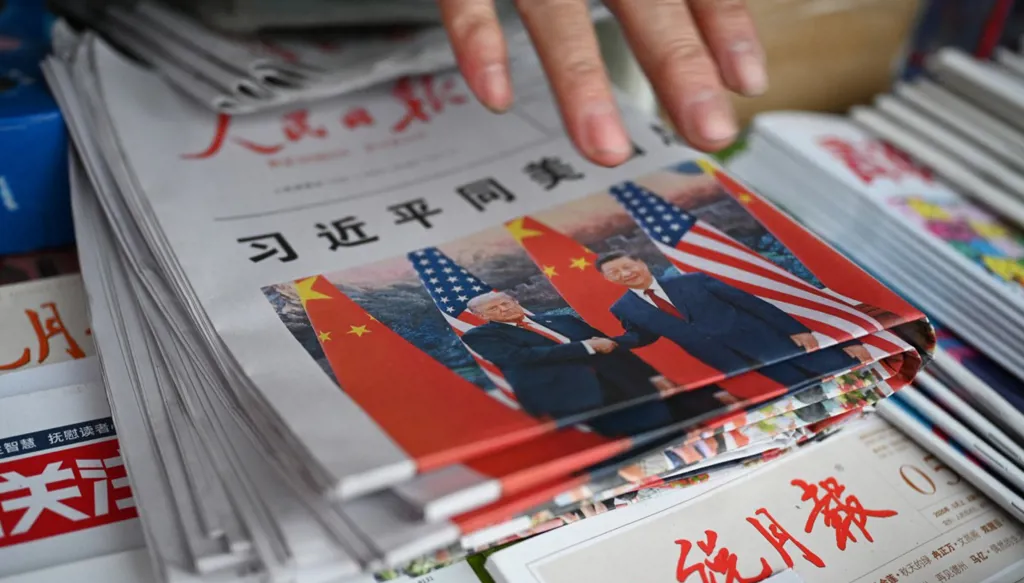
The world's newspapers followed the Sino-American summit (AFP)
Smaller Bigger


It is evident that the technological front will become the main axis of conflict between China and the United States in the coming years, centering primarily on who controls the infrastructure of artificial intelligence, semiconductors, data, and digital communications.


This is, in essence, a clash between two fundamentally different models of organizing technological power: an American system in which that power has largely shifted toward private technological monopolies, and a Chinese system in which the state has fused with technology to create an unprecedented phenomenon in human history. Understanding this distinction appears to be key to understanding the most dangerous competition of our time.


The American technological system is, officially, a liberal democracy. Yet the past two decades have witnessed a quiet revolution at the center of real power. A small number of technology companies now possess capabilities that far exceed those of most states. This oligarchy is not merely a wealthy class, but also the custodian of what can be described as critical infrastructure.


Structural Difference


By contrast, the Chinese model differs structurally. Although the Communist Party did not nationalize the technology sector in the crude manner of Soviet industrial policy, it adopted a more sophisticated approach. It fostered the growth of a vast private technology sector while maintaining decisive political control over it through a combination of regulatory pressure, ownership stakes, and the presence of party committees within companies, alongside the ever-present threat of swift and decisive intervention.


The Chinese state has also sought to achieve a goal that the American state has largely abandoned: a coherent national technological strategy that integrates the development of military and civilian technology as a formal political doctrine. While the American technological oligarchy acquired geopolitical significance largely as a byproduct of market success, the Chinese technological state attained that status through deliberate design.


The conflict between these two systems, in its most basic form, will not resemble the wars of the 20th century. There will be no traditional fronts or clearly defined battles, but rather a continuous struggle already unfolding across several intertwined domains. The first is the semiconductor supply chain, where U.S. export controls targeting advanced chips and their manufacturing equipment represent an attempt to weaponize the one field in which the American technological elite still retains decisive global advantages. The second domain is data and artificial intelligence, where China’s structural advantages in data collection constitute a significant long-term strategic asset.

The third domain is the battle over global standards. Whoever establishes the technical standards for 5G networks, AI governance, digital payment infrastructure, and internet protocols effectively shapes the rules of the global technological order. China has pursued an effective strategy of standards diplomacy through institutions such as the International Telecommunication Union, while the United States has remained preoccupied with the tension between the state and the private sector. American technology companies often favor standards that reinforce their market dominance rather than those aligned with a broader national strategy, leaving the U.S. response slower and less cohesive.


However, one of the most troubling aspects of this emerging conflict lies in its implications for democracy itself. Neither model is democratic in the literal sense. Even the American model increasingly entails critical technological decisions being made by private sector actors who are not subject to meaningful public accountability.


Not a Repeat

Nevertheless, this anticipated conflict is not merely a repetition of the Cold War with different actors, but a new structural struggle between a state that absorbed technology and technology that, in some respects, has begun to surpass the state itself. It will determine not only which countries emerge as the most powerful, but also what kind of power the future will reward: centralized authority or unaccountable private control. Yet what remains absent from both models, and what this conflict will ultimately put to the test, is a deeper question: can society reclaim genuine sovereignty over the technological forces that increasingly shape human life today?


Disclaimer: The opinions expressed by the writers are their own and do not necessarily represent the views of Annahar.