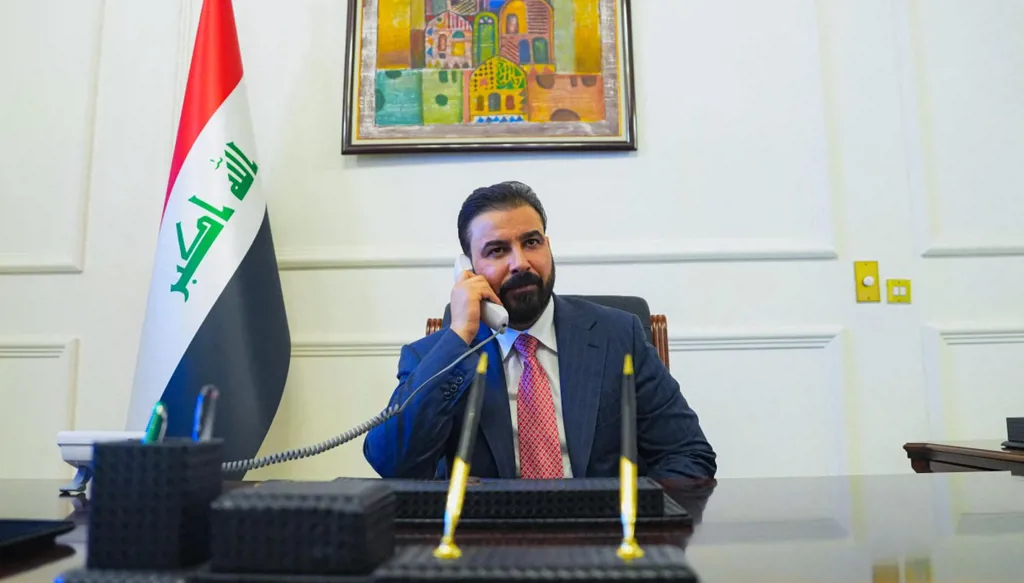
The appointment of Ali Al-Zaidi to form the new government cabinet was an unprecedented political move in Iraq.
This step brings numerous challenges for the appointee himself and for the coordination framework, which relied on Article 76 of the Iraqi Constitution, a lifeline from a crisis that nearly ended this entity founded on interests and Iranian discipline.
Al-Zaidi’s entry into the realm of political ideologies, managing state institutions divided as spoils among parties, neutralizing and confronting parallel armed forces, and maintaining a delicate balance between Washington and Tehran represent complex issues that require new approaches, signaling the beginnings of a different trajectory that may not appear immediately but will require time, determination, and a team of minds thinking beyond narrow gains.
Ali Al-Zaidi emerges without the shadow of any ideology; he has no affiliations or prior political stances or statements on internal or external affairs. As such, he cannot be categorized within Shiite political Islam, which has governed Iraq, despite being “somewhat close” to influential leaders in state decision-making.
His lack of commitment to a political creed may allow him flexibility in dealing with sects, but at the same time, he may face difficulties in understanding these systems and their interactions with the state, regime, and even the people. This requires him to establish a national political template that can earn acceptance from independent Iraqi elites.
A consensual first statement
Al-Zaidi states in his first political declaration: “We have gained great acceptability, and everyone will participate in a government with a solid and strong economy.” While this statement may seem ordinary, it carries his political concerns and general principles, as it places acceptance of his nomination for the executive position as a significant interest, since he is from outside the system that has held the scene for over two decades.
Thus, he considers this acceptability the first step in convincing traditional leaders of a figure from outside their controlled environment, and in gauging party responses to his implementation of his program, which will be submitted to parliament for a vote of confidence.
He appears to have overcome his biggest concern, enabling him to move forward, especially after gaining the endorsement of U.S. President Donald Trump for his nomination and working with his “terrorism-free” government.
In his sole statement, the appointee outlined the form of the upcoming government as “inclusive” of all winning blocs, reviving the coalition model adopted by five previous prime ministers, who treated consensus as an open-ended source of support given the distribution of executive authority.
Political obstacles ahead
However, most of these consensus-based governments failed to advance their programs due to political disputes that often obstructed state institutions, placing Al-Zaidi before the challenge of overcoming this obstacle by establishing an approach that enables ministerial harmony rather than merely seeking political consensus among his government members, thereby achieving a reality different from that of his predecessors.
An economically-oriented government
The appointee described his upcoming government as economically oriented, an important characterization reflecting Al-Zaidi’s alignment with the commercial and financial environment in which he grew up, on one hand, and his awareness of the economic and financial crises attributed to Mohamed Shia Al-Sudani’s government, both internally and externally, on the other hand, as well as the poor economic management of previous governments that maintained a non-productive rentier oil economy now threatened by the potential closure of the Strait of Hormuz by Iran.
The Iraqi economic crisis will test his background as a businessman and banker, requiring him—while his plan is still awaited—to restructure the economy and create genuine development, making it “solid and robust,” as he stated in his first declaration.
Disclaimer: The opinions expressed by the writers are their own and do not necessarily represent the views of Annahar.



 Messenger
 Whatsapp
 Threads
 Email
Email
 Print
Print
 X
X
 Facebook