

Lebanon between fragile negotiations and the path of sovereignty
A tentative Washington-backed dialogue with Israel highlights shifting regional realities, but lasting peace remains tied to ending militia control over war and peace decisions in Lebanon and restoring full state sovereignty.


 Messenger
 Whatsapp
 Threads
 Email
Email
 Print
Print
 X
X
 Facebook
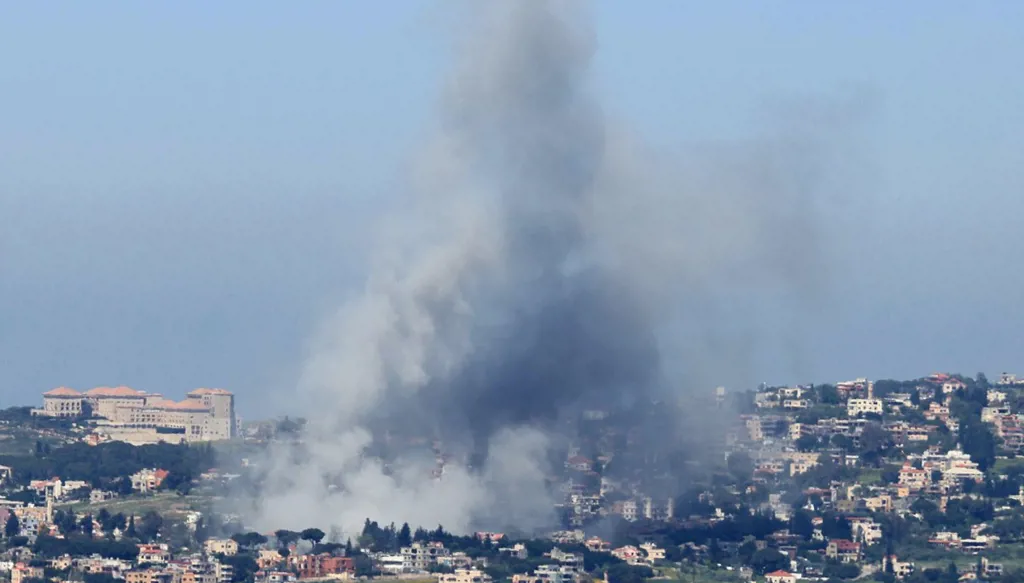


The second Washington round between Lebanon and Israel did not lead to a decisive breakthrough, but it opened a political track that had not been available a few months earlier.
It is true that the extended ceasefire remains fragile and that the south is still under pressure, violations, and warnings. However, it is also true that Lebanon’s shift toward this direct path reveals that something significant has changed inside Lebanon and in its surrounding regional environment. It also shows that the file has moved away from the traditional French umbrella into a negotiating track directly and almost exclusively sponsored by Washington.
The imposition of a new security reality
What we are witnessing is not the result of a sudden change in the political stance on peace, but rather a new security reality. The obstacle posed by Hezbollah, which has paralyzed the Lebanese state for decades, has begun to weaken. Along with it, the veto that had monopolized the decisions of war and peace and turned Lebanon into an open front serving calculations beyond its own interests has started to recede.
As a result, the real challenge has become Lebanon’s ability to act as a state that controls its own decisions, borders, and security. It is a clear contradiction that the party which monopolized the decisions of war and peace outside the state for years is now calling for a national consensus on negotiations.
A different regional dilemma
To understand what is happening today, it is necessary to go back to the May 17, 1983 agreement. At that time, the agreement collapsed because Lebanon did not control its own decision making, and because the Syrian veto was stronger than the Lebanese state itself.
Today, the obstacle is different in form but similar in essence. The veto is no longer Syrian, but Iranian through Hezbollah. However, the current moment differs from the 1980s in a fundamental way. The region has changed, Syria has changed, and the Arab world has changed. Lebanon is no longer able to remain hostage to weapons that keep it an open arena for the wars of others.
Speaking about opportunities for peace between Lebanon and Israel does not appear to be solely an Israeli interest, as some try to portray it. Lebanon’s first interest is to move away from the logic of a permanent front. The interest of the Lebanese people is for security decisions to return to the state and the army, not to an armed organization linked to external leadership.
The interest of the region is to separate Lebanon from regional war and to stop Tehran from using its territory as a parallel bargaining chip. This aligns with the Emirati position supporting a ceasefire and restricting weapons to the state. Lebanon’s stability is no longer a purely Lebanese matter but has become part of broader stability in its Syrian and Arab environment, and part of Gulf security as well, in the face of the logic of proxies and militias that do not respect truces or sovereignty.
Security and development as Arab priorities
Any realistic reading of the situation must link security with development. Lebanon, without a militia holding the decision of war and peace, becomes more able to attract Arab investment, especially from the Gulf, and more capable of restoring tourism, services, and financial confidence.
Opening even a fragile negotiating horizon reduces the cost of risks and brings Lebanon back into investment and reconstruction calculations. Lebanon’s security is also tied to Syria’s security and vice versa, because the continued existence of Hezbollah as a cross border armed organization means keeping both countries within an environment of infiltration, smuggling, and disorder.
At the same time, it is important not to exaggerate optimism. What is happening so far is still closer to necessity driven negotiation than to a complete peace. Its fragility increases with the pressure of time, Israel’s desire to quickly determine the direction of negotiations, and the continuation of field confrontations.
Israel is entering this process from a position of clear military superiority, and its calculations still raise serious questions in light of its insistence on a buffer zone and what is known as the yellow line. The Lebanese state, despite its boldness, still faces Hezbollah, absent from the negotiating table but present on the ground. For this reason, the realistic ceiling in the current phase may be a temporary agreement of a security nature, or broader arrangements that later pave the way for something larger.
Despite all these constraints, the broader picture is clearer than ever. Real peace in Lebanon does not begin with the form of an agreement or the name of a process, but from the day Hezbollah’s monopoly over the decision of war and peace ends, and Lebanon returns to being a fully sovereign state, no longer run by a militia or used as a battlefield for others’ wars, but moving back onto a path of stability and development.
Disclaimer: The opinions expressed by the writers are their own and do not necessarily represent the views of Annahar