

Lebanon's struggle: U.S. guarantees vs Iranian influence


 Messenger
 Whatsapp
 Threads
 Email
Email
 Print
Print
 X
X
 Facebook


The Speaker of Parliament, Nabih Berri, had barely published a statement in which he reaffirmed his rejection of direct negotiations with Israel and “contradicted” President Joseph Aoun’s claim that there is no difference between the agreement to halt hostilities on November 26, 2024, and the U.S. State Department’s announcement of a ceasefire on April 14, when he received a phone call from Iranian Foreign Minister Abbas Araghchi.
Reports about the content of this call clearly show that Tehran, together with the “Shiite duo,” is leading a campaign to undermine the American diplomatic track aimed at separating Lebanon from the Iranian axis, and therefore to block the approach of direct negotiations included in Aoun’s initiative.
This comes after Hezbollah once again opened the Lebanese-Israeli front “in revenge for Supreme Leader Ali Khamenei,” in full coordination with the Iranian Revolutionary Guard, the Houthis, and the Islamic Resistance in Iraq.
Following the call, the Iranian Foreign Ministry announced that Araghchi had emphasized in his conversation with Berri that “the cessation of Israeli attacks on Lebanon is included in the agreement between Tehran and Washington, and that this file will remain of interest to Iran in any future process.”
This statement clearly indicates that Tehran rejects the idea of the ceasefire being a purely American decision or the result of the first preparatory meeting for direct negotiations held at the U.S. State Department between Lebanon and Israel at the level of the two countries’ ambassadors in Washington. It therefore does not see any need for Lebanon and Israel to sit face to face to stop the fighting.
Before Araghchi’s call, the commander of the Quds Force, Esmail Qaani, had issued a more escalatory position, stating that Iran’s efforts at this stage are focused on supporting Hezbollah, expressing his belief that victory will go to the party and to the “axis of resistance.”
These Iranian positions largely explain the course of events: Hezbollah’s refusal to recognize the U.S. ceasefire announcement, attempts to impose new rules of engagement, and the Speaker of Parliament’s distancing from the President’s initiative, despite having visited the presidential palace after it was launched and expressed full support for Aoun, describing him as a guarantee, without recording any opposing stance toward the content of the initiative.
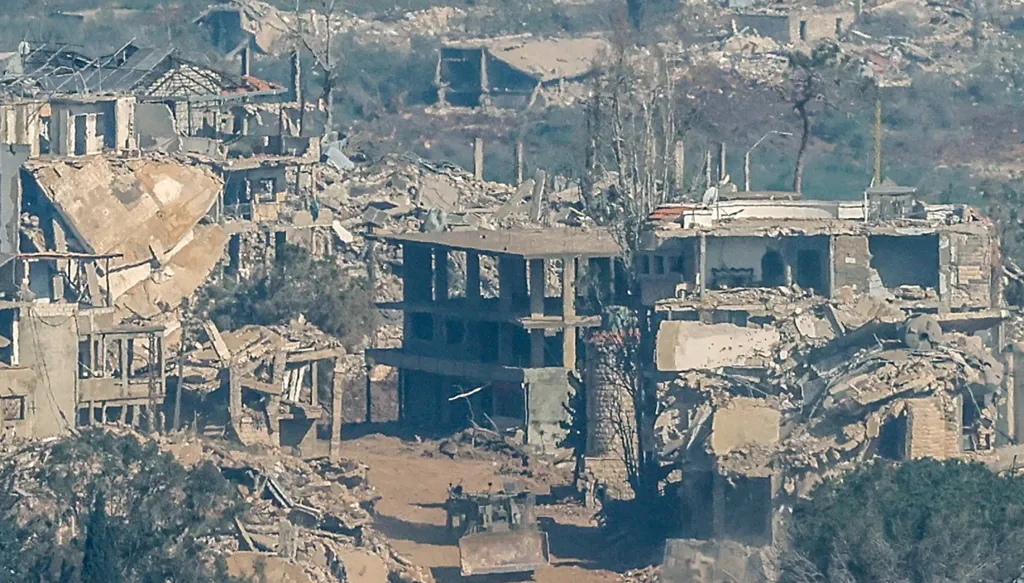
They also explain the gradual return to military escalation, along with the accompanying airstrikes, destruction, and casualties, not only south of the Litani River but also to the north.
American “historic commitment”
In contrast, the U.S. administration continues to deepen its approach. The day after Berri’s positions, which were supported and coordinated with Iran, Washington deliberately issued clear statements, whether through U.S. President Donald Trump’s confirmation that direct negotiations between Lebanon and Israel would be held within the next two weeks, or through the notable statement issued by the U.S. Embassy in Beirut.
The statement included a promise to provide Lebanon with a package of guarantees if a meeting were to take place between Lebanese President Joseph Aoun and Israeli Prime Minister Benjamin Netanyahu under Trump’s sponsorship.
The embassy indicated Washington’s readiness to stand by Lebanon, saying that holding a direct meeting between Aoun and Netanyahu would give Lebanon the opportunity to obtain concrete guarantees for its full sovereignty, territorial unity, and secure borders, in addition to securing humanitarian support and reconstruction assistance.
At the same time, the embassy warned that Lebanon “today stands at a crossroads, and before its people lies a historic opportunity to reclaim their country and shape its future as a truly sovereign and fully independent state,” noting that “direct engagement between Lebanon and Israel, two neighboring states that should never have been in a state of war, could mark the beginning of a national revival.”
This means that Washington is officially informing Lebanon that aligning with the Iranian axis and remaining in a state of confrontation with Israel would lead to losing the historic opportunity for recovery and sovereignty, and would prevent it from securing reconstruction with American guarantees.
On the other hand, Iran, at this stage, does not appear to want Lebanon to exit the confrontation. Instead, it offers to sponsor a ceasefire process under conditions that would place Hezbollah in the position of a victor.
Accordingly, the challenge facing the executive authority in general, and President Joseph Aoun in particular, appears significant. The statement of guarantees and warning issued by the U.S. Embassy seems, in a way, as though it were drafted in the presidential palace itself, as it summarizes Lebanon’s demands, which appear to have no alternative except further escalation, an expansion of the scope of destruction, and a rising national cost.
Disclaimer: The opinions expressed by the writers are their own and do not necessarily represent the views of Annahar.