

How AI is reshaping the meaning of work


 Messenger
 Whatsapp
 Threads
 Email
Email
 Print
Print
 X
X
 Facebook
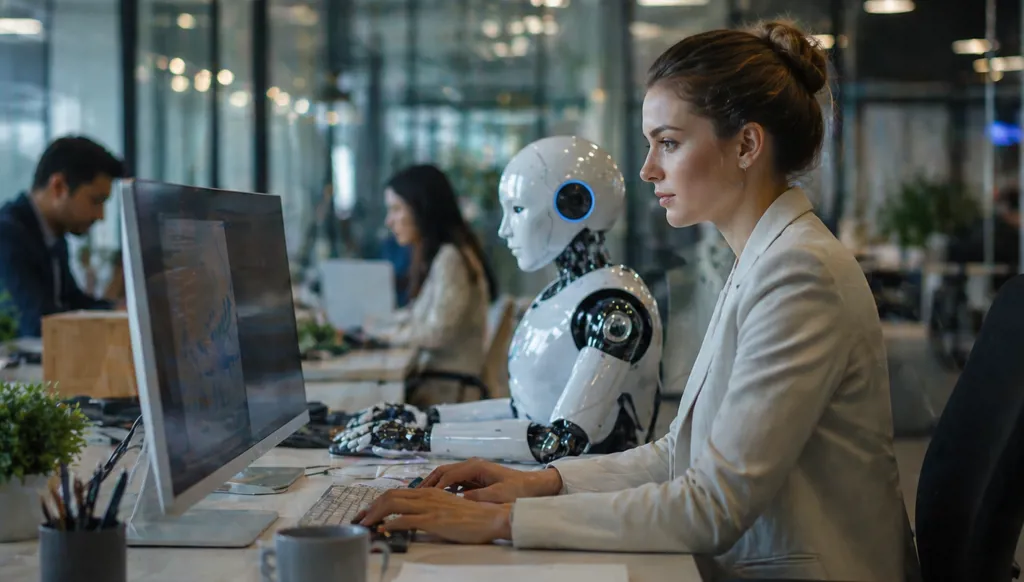


Artificial intelligence has become an active and, in some cases, a central component in most institutions and at the heart of work environments, not merely as a technological tool, but as an element that is reshaping the way work itself is done. The ongoing transformation does not mean the disappearance of jobs, but rather a change in their nature from within.
A job is no longer a fixed template, but a set of tasks that change with every new tool. In this context, the rules of competition are also changing; they are no longer limited to individuals alone but now exist between those who adapt to this transformation and those who lag behind it.
Contemporary analyses of the labour market show that the vast majority of jobs are likely to continue, but in a different structure. AI based systems are moving toward handling routine and automated tasks, such as data processing, preparing initial reports, and performing calculations, while the human role is increasingly focused on tasks that require analysis, contextual understanding, and decision making.
This shift does not reflect a decline in the role of humans, but rather a redistribution of functions within the work environment toward higher value activities. In this sense, a job is no longer a fixed entity, but a dynamic structure made up of tasks that can be continuously reshaped.
This transformation is evident across a wide range of sectors and is not limited to specific fields. In media, AI tools are used to produce initial drafts of texts, without eliminating the journalist’s role in verification and analysis.
In programming, algorithms write parts of code, while the engineer remains responsible for designing the overall system architecture. In financial analysis, intelligent systems reduce processing time, while interpretation and decision making remain in human hands.
The same applies in medicine, where AI technologies contribute to supporting diagnosis and analysing medical images, without replacing the doctor in final evaluation. In education, these tools are used to personalize learning content, while the teacher retains their role in guidance and interaction.
They also appear in marketing through the analysis of consumer behavior, in law through document review, and in customer service through initial automated responses. These examples reflect a single reality: the transformation does not target a specific profession but rather redistributes tasks within most of them.

In contrast, this reality imposes new standards for staying relevant. Traditional experience or an academic degree is no longer sufficient. Today’s value lies in the ability to adapt and understand how to use these tools effectively.
An employee who is skilled at working with artificial intelligence becomes more productive and more competitive. Those who resist this transformation or are slow to adopt it face the risk of gradual decline in the labour market.
However, this transformation is not without challenges. The gap between those who possess digital skills and those who do not is clearly widening. Groups that are able to adapt are gaining better opportunities, while the prospects of others are shrinking.
This does not mean that jobs are disappearing, but rather that their value within the market is changing. With the acceleration of this shift, continuous learning becomes an essential requirement rather than an option.
In this context, the concept of work is undergoing a structural transformation. Job titles no longer accurately reflect the actual nature of roles, as tasks have become the basic unit of analysis and organisation. With rapid technological development, these tasks are being redistributed between humans and machines, so that artificial intelligence becomes an active partner in the workplace, or what can be described as an algorithmic colleague.
The relationship between the two sides is based on complementarity rather than replacement; artificial intelligence provides speed and precision in processing, while humans retain the abilities of understanding, contextual awareness, and judgment.
The question is no longer about the survival of the job, but about the individual’s ability to keep up with its transformations and continue within its new conditions.