

Kfarkela reduced to ruins as residents scatter and long for return


 Messenger
 Whatsapp
 Threads
 Email
Email
 Print
Print
 X
X
 Facebook
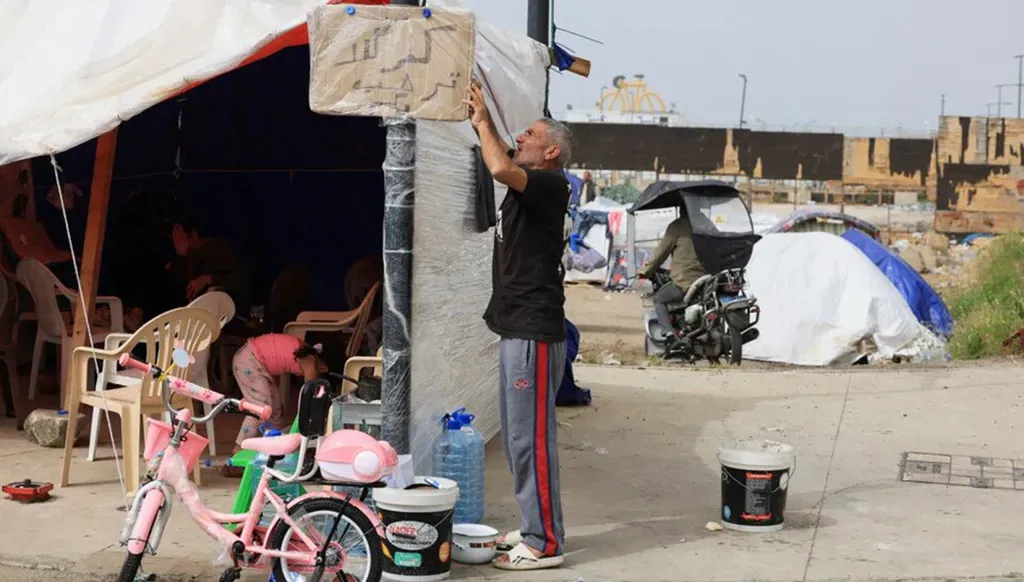


In a garbage-filled parking lot near the Mediterranean coast in Beirut, Hassan Yahya stuck a cardboard sign onto a traffic light pole next to a tent that has now become his home.
On the sign, he wrote in thin handwriting: “Kfarkela welcomes you.”
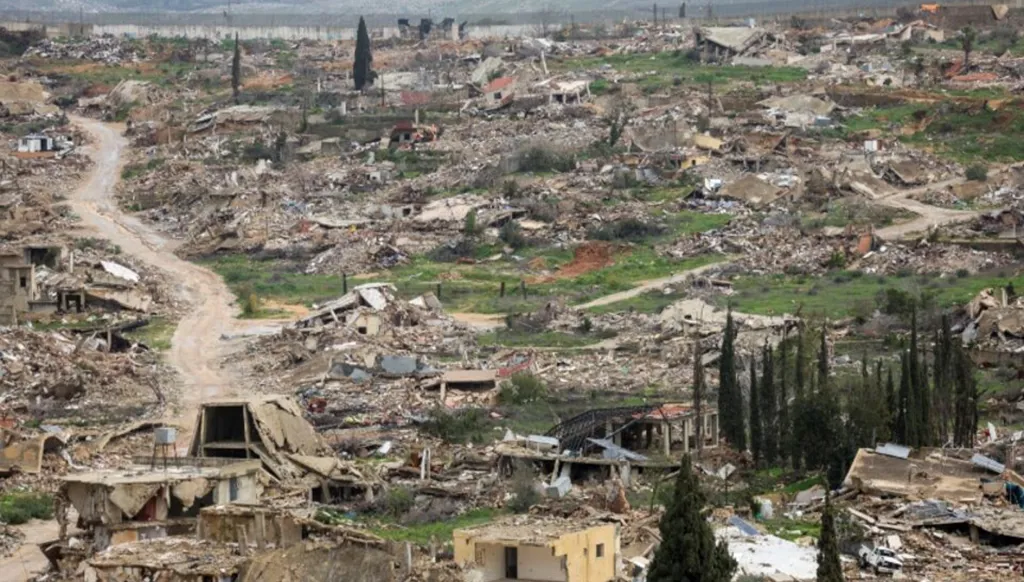
The worn-out sign brings back the image of a former road sign that once stood dozens of miles away at the entrance of the historic town of Kfarkela, whose history goes back decades. Kfarkela is one of more than ten villages along Lebanon’s southern border that were gradually flattened by waves of Israeli bombardment over two and a half years.
Now, as Israeli forces advance, carry out controlled explosions, and use bulldozers, villages are being effectively erased, turning once lively areas into barren spaces that appear as if life has left them.
Like tens of thousands of residents of the south, Yahya stands helpless as he watches his ancestral land being turned into a “buffer zone” that Israel is clearing to secure its borders.
In Lebanon, villages hold deep cultural significance for their people. They are centers from which families across the country and the world trace their roots, maintaining connections through investment in homes and through community ties shaped by weddings, holidays, and olive harvest seasons.
Almost everyone knows their family village, or “the village,” even if they left it generations ago. The sudden disappearance of these residential areas has displaced hundreds of thousands of people.
Yahya, 58, said while sitting on a plastic chair in his tent with a generator running behind him: “Like fish, if it leaves the water it dies. We cannot leave it. We will die.”
Israeli forces say that Kfarkela and other destroyed villages were strongholds for Hezbollah, which has been engaged in military confrontations with Israel since the Hamas-led attacks on southern Israel on October 7, 2023, after which the region entered a cycle of unrest.
The Israeli army told Reuters that it classified Kfarkela as a “major Hezbollah village” and said it contained “extensive terrorist infrastructure,” some of it located inside homes and schools.
It added that Israeli forces had seized weapons equivalent to 90 truckloads there in 2024 and confiscated more this year. The army said it worked hard to minimize harm to civilians, according to its claim.
To understand life in one of Lebanon’s vanished villages, Reuters spoke to five former residents of Kfarkela who ended up in different parts of the country, and used satellite images, social media posts, photos, and videos they and others shared to reconstruct what happened to the village and its people.
Before the war broke out in 2023, about 5,500 people lived there, according to Hassan Sheit, the mayor of Kfarkela. Agriculture was the main activity. The favorable climate allowed the cultivation of diverse crops ranging from wheat and grapes to watermelon, tobacco, tomatoes, parsley, beans, and olives.
He added that the village was known for its olive oil, which was sold across the country and attracted buyers from distant areas such as Beirut.
Daily life was vibrant around bakeries, restaurants, and cafés, where residents gathered to play cards and exchange conversations and jokes. At weddings, celebrations lasted for a week. On Ashura, residents gathered in the center of the village to commemorate the martyrdom of Imam Hussein, and they climbed onto rooftops to watch men dressed in traditional historical costumes reenact the Battle of Karbala.
“Everything turned to ashes”
Shait says that Kfarkela experienced relative prosperity during most of the two decades preceding the October 7 attacks, as schools and clinics were opened, education levels rose, and horizons expanded thanks to roads leading to the city of Nabatieh and other nearby centers. Emigrants in Europe, the Gulf, and Africa were sending money back to their families.
Yahya’s nephews, who live in Sweden, managed to build a house next to the “Fatima Gate,” a historic border crossing that became a local destination with the spread of restaurants near a structure resembling the Dome of the Rock in Jerusalem, as well as the spread of graffiti on the wall built by Israel along the border. Yahya himself built a three-story house of concrete and stone in the village and set up an oven in the basement to make pastries for his friends.
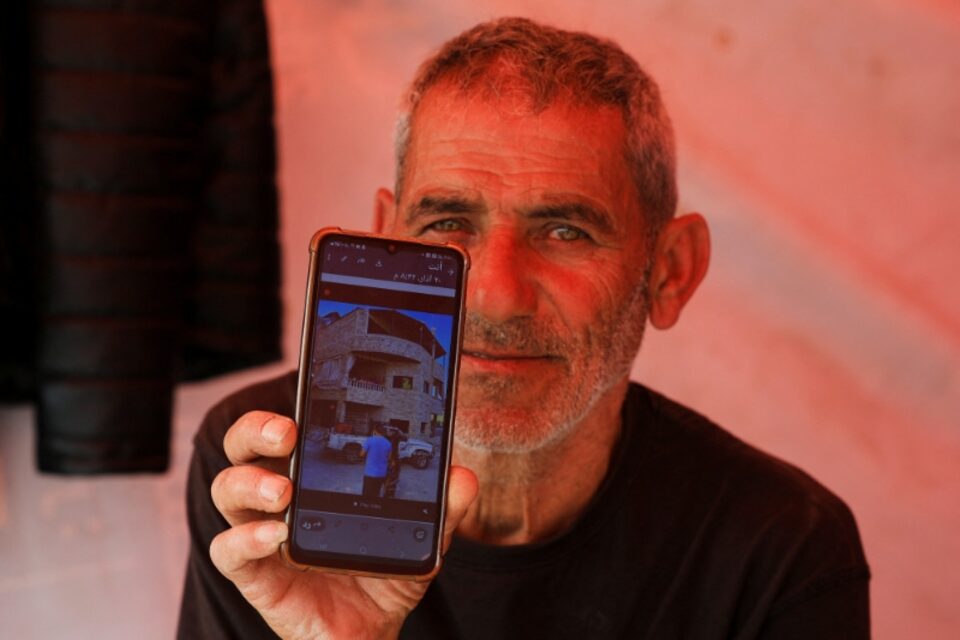
Shortly after the war began, Yahya moved north from Kfarkela before eventually settling in Beirut. His neighbor and childhood friend, Khodr Hammoud, settled near the Syrian border.
As for Jamil Fawaz, a grocery store owner whose shop and home were destroyed, he first fled to the southern town of Habboush and then to a school in the coastal city of Sidon that is sheltering hundreds of people who lost their homes.
Sitting by a wall in the school covered with dozens of paper signs placed by displaced residents, listing the names of villages destroyed by the war, including Kfarkela, Fawaz said: “Everything turned to ashes.”
Shattered hopes of return
The ceasefire in November 2024 encouraged some residents to return. Sheit said that at that time, around 85 percent of the buildings in Kfarkela had been destroyed. Among them was Yahya’s newly built family home, which had been completed just before the war.
Some residents, including Hammoud, set up prefabricated houses near the ruins in the hope of reconstruction. In February of this year, Prime Minister Nawaf Salam visited Kfarkela and promised residents that reconstruction would begin soon.
An Israeli military official told Reuters: “We destroyed more than 90 percent of the homes in Kfarkela by late April.”
With hopes of a near return fading, many former residents of Kfarkela now rely on intermittent communication to maintain family ties. Yahya says that in cases of death, they now limit themselves to offering condolences by phone. Shait says that weddings, if they happen at all, are usually held without celebrations.
Despite Israel saying the buffer zone is temporary, many Lebanese fear it may become permanent. Israel annexed the Golan Heights in 1981 after capturing it from Syria in the 1967 war. The West Bank, which Israel also occupied in that war, is now home to hundreds of thousands of Israeli settlers.
One day this month, Hammoud drove his battered sedan from the northern mountains to a parking lot in Beirut to visit Yahya.
The two walked together, remembering their youth, with Hammoud leaning on his late mother’s cane, one of the few items he managed to save from his home.
He said: “We can no longer replace these houses; we can no longer replace the livelihoods we had. Everything in the village was old and meaningful to us, symbolic. Our old homes are our parents’ homes, our grandparents’ homes. Everything has meaning.”
Sheit echoed this while sitting in his uncle’s home in a village in the central mountains of the country where he had taken refuge.
He added: “There is a spiritual bond, a psychological bond, a bond to our roots, a very strong bond. This is fundamental for Kfarkela… It will take time for sure, but when we return, we will rebuild.”
He paused, then added: “These are not just words. We will return.”