Two preliminary meetings took place at the White House and the U.S. State Department regarding the path toward direct negotiations between Lebanon and Israel. Donald Trump reiterated his invitation for a meeting between the Lebanese President and the Israeli Prime Minister, disregarding feedback from intermediaries and advisors that conditions were not yet ripe for such a meeting and that Lebanon had defined the goal of the negotiations as ending the war and resolving the resulting issues.
As for Benjamin Netanyahu, he considers that a path toward achieving a “historic peace” between Israel and Lebanon has begun, placing it within the context of the “Middle East transformation” he is pursuing. Although Trump and Netanyahu have used their agreement to negotiate to “separate Lebanon from Iran,” their leap to a “peace agreement” as a final outcome involves skipping stages and bypassing numerous details. It also marginalizes the regional and geopolitical dimensions of this desired “peace,” without taking into account its repercussions on Lebanon’s internal situation.
The U.S. and Israeli push relies on military superiority
The U.S. and Israeli push relies on military superiority to impose the terms of the victor and apply the concept of “peace through strength,” without consideration for the repercussions on the region, which the U.S. and Israel do not view through the same lens.
Despite the coordination between them, a genuine “peace model” has yet to materialize: in Gaza, Netanyahu continues to dismantle what Trump celebrated achieving more than six months ago, and his “plan” still falters, while Israel exploits time to intensify the impacts of starvation and extermination against the Palestinians.
In Syria, freed from the presence of Iran and “its party,” Washington has built security interests with the new regime, particularly in combating “ISIS,” with Arab and regional support, and did not require it to sign a “peace agreement” with Israel. Instead, it exerted maximum pressure to stop Israeli interventions and attacks and to negotiate with Damascus, but failed to convince it to accept a “non-aggression pact” or any security agreements that would include Israeli withdrawal from Syrian territories outside the occupied Golan.
Insistence on isolating Lebanon to impose 'peace through strength'
What about Lebanon? It is clear that the U.S. and Israel, as well as Iran and “its party,” interact with Lebanon from the perspective that they have all contributed, both directly and indirectly, to its weakening. Although the Lebanese government requested direct negotiations, the insistence on a meeting between President Joseph Aoun and Netanyahu went beyond undermining and amounted to isolating Lebanon and imposing “peace through strength” upon it, amid serious threats in Congress to halt aid to the Lebanese army if it did not take the initiative to disarm Hezbollah.
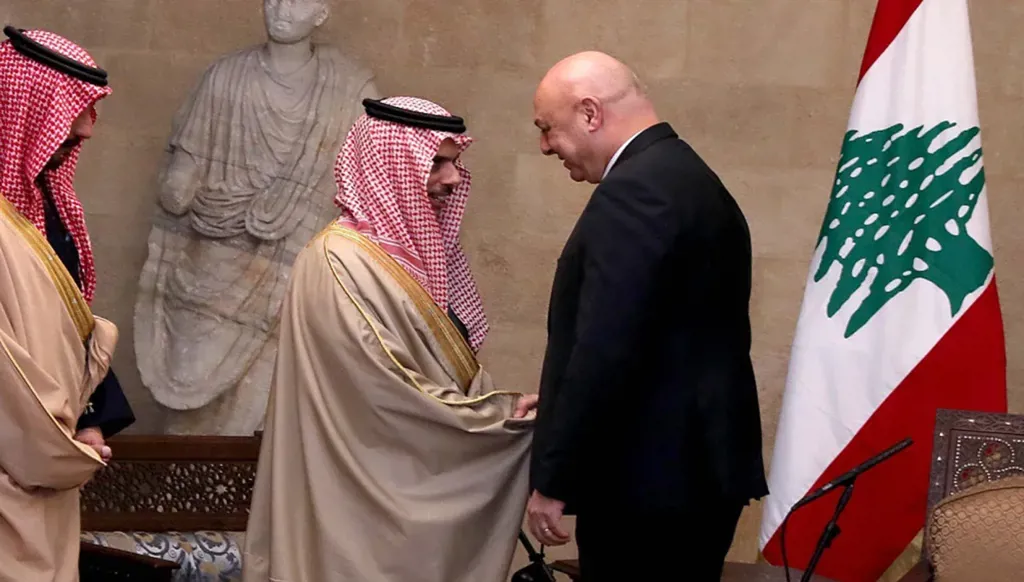
The Lebanese government seeks to avoid such pressure by invoking its commitment to the “Arab Peace Initiative.” This has brought Saudi Arabia back to playing a mediating role within Lebanon, especially as Riyadh also invokes that “initiative” to remind Israel of its obligations toward Palestine before it can achieve “normalization” with it. However, this initiative, later echoed by Arab and international initiatives, lost its momentum first due to Israel’s and the U.S.’s actual rejection, and later due to the wars that followed over more than a quarter of a century since it was adopted by the Arab Summit in Beirut in 2002.
Saudi support for Lebanese negotiations could be influential in Washington, but it has become urgent to activate the regional understanding (Saudi Arabia, Egypt, Turkey, and Pakistan) to safeguard the interests of Lebanon and other regional states against unthought-out or unrealistic Trumpian options.
It is especially critical to rationalize the arrangements for the upcoming regional phase and not leave them to Netanyahu’s whims and his circle or to an Iranian project that Tehran can no longer achieve merely by relying on weapons stockpiles delivered to militias outside the state. What compels the Arab-Islamic quartet to bolster its role is that its actions enjoy broad international acceptance and do not challenge Trump-era America, but it is called upon to act swiftly to prevent the isolation of Lebanon.
The current approach to Lebanon, as seen in Washington meetings, does not suggest that “peace” is a genuine goal, but merely a byproduct of the American-Israeli war on Iran.
Trump first announced the truce then canceled its effects
The best that could be achieved so far is a non-effective ceasefire in southern Lebanon. There is no commitment from Israel, nor from Iran and “its party.” Not a day passed during the 10-day truce without casualties and destruction, and this situation will not change in the three-week extension, because Trump, who announced the truce, undermined its effects by linking it to Israel’s continued exercise of its “right to self-defense.”
Therefore, repeated violations of the truce become a recipe for extremely difficult negotiations: first, because they would be conducted with complete disregard for Lebanon’s condition that they begin with a firm ceasefire. Second, because the response to Lebanese demands is tied to the state’s progress in disarming the “party.” Third, because Trump and Netanyahu are both rushing toward a “peace agreement” despite the lack of groundwork or facts indicating that conditions are ready for its conclusion, whether due to the issue of Hezbollah's arms and the internal questions it raises, or because the Israeli–American conditions are not conducive now and are unlikely to be so later.
Disclaimer: The opinions expressed by the writers are their own and do not necessarily represent the views of Annahar.



 Messenger
 Whatsapp
 Threads
 Email
Email
 Print
Print
 X
X
 Facebook