How Anghami, the Arab World’s leading music streaming app, became a psychological lifeline in Lebanon’s war-time reality

Art 27-04-2026 | 10:53

How Anghami, the Arab World’s leading music streaming app, became a psychological lifeline in Lebanon’s war-time reality

Anghami usage patterns reveal shifting listening habits in Lebanon, where music evolves from entertainment into emotional support, cultural identity, and crisis coping during war.
How Anghami, the Arab World’s leading music streaming app, became a psychological lifeline in Lebanon’s war-time reality
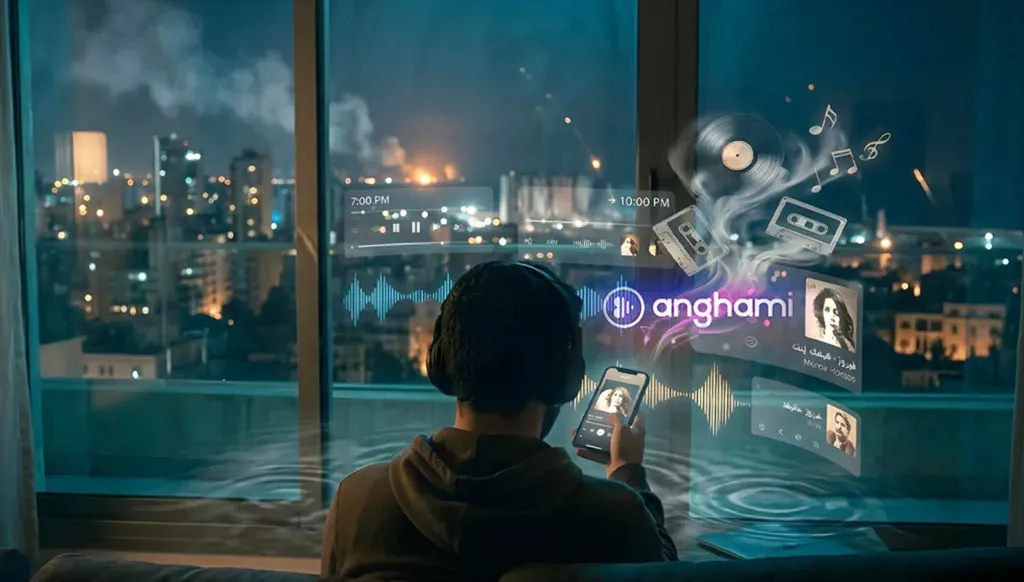
Illustrative image (Annahar)
Smaller Bigger


In an approach resembling a digital behavioral study, data from "Anghami", the largest music app in the Arab world, serves as an indicative sample within Lebanon's digital scene, revealing a qualitative shift in music listening habits during the war. The use has extended beyond mere entertainment to encompass deeper psychological and functional dimensions.



Anghami platform
Anghami platform


From daily routine to private listening
 

In this context, figures are not merely technical indicators but an entry point to understanding a collective behavior redefining its priorities. According to the music streaming platform: “While we noticed a temporary fluctuation in usage, specifically a decrease of up to 20%, primarily in southern regions due to displacement and infrastructure challenges, the overall picture in Lebanon shows resilience.


This high level of user retention indicates that interaction remains strong even in the toughest times. This reflects how deeply ingrained music is in people's daily lives, continuing to provide a sense of familiarity and continuity when it's most needed.”


Despite this localized decline, the core listening behavior remained constant. The data indicates that “interaction levels and listening durations remained remarkably stable. This suggests that despite the chaos, users set aside specific, consistent times to engage with audio, using music as a constant in an unpredictable environment.”


However, this steadiness does not negate subtle shifts in usage patterns, notably in the timing of listening. According to the platform: “We observed a behavioral shift. Before the recent escalation, peak listening typically occurred at 7 PM (after work/commuting). Now, the peak has notably shifted to around 10 PM. This suggests a move towards ‘private listening’, where music is more likely used as a companion for relaxation, reflection, or emotional release at the day’s end.”


Though one might expect an increase in downloads as a backup option, the figures reveal otherwise, indicating that “interestingly, downloads remained largely stable and were not significantly impacted during the escalation period. Despite the uncertainty, users did not shift markedly toward offline listening. This suggests that listeners continued relying on live streaming as their primary means of music consumption, even in unstable periods.”


Expressive Image (Pexels)


Between collective identity and personal retreat


At the taste level, a striking paradox emerges between the collective and the individual, where “we noticed two very clear emotional trends: on one hand, there was a noticeable increase in national music, as listeners naturally gravitated towards songs that reinforce a sense of identity and unity.


On the other hand, we observed a sharp rise in consumption of white noise and calming sounds. It's a balanced behavior: through national anthems, users seek a collective sense of resilience, while using calming audio to find a personal sense of focus and control in a stressful environment.”


Concurrently, listeners returned to their music archives. The platform indicates a “strong return to the music archive, particularly to iconic voices like Fairuz and Julia Boutros. Such figures are not just artists; they are cultural anchors. In challenging times, listeners tend to steer away from ‘new’ songs and revert to familiar, timeless music that evokes nostalgia and comfort. It’s about finding a safe, familiar sonic space when the external world seems unstable.”


This shift also reflected on playlists, where “while trendy songs largely maintained top spots, national and emotionally charged songs appeared more frequently compared to pre-escalation. This is evident in the data, with Fairuz's 'Li Beirut' topping the 'TRENDS Lebanon' Arabic chart in Lebanon. This indicates a clear shift in listening behavior, as audiences seek music that reflects their emotional state and adds a deeper cultural dimension to their listening experience.”


How Anghami redefined the listening experience

 

In a clearer dimension, music establishes itself as a tool of direct psychological support. The platform confirms that “one of the most prominent indicators was the increase in listening to white noise and calm, environmental content. Additionally, the ‘Moments of Calm’ section on Anghami’s homepage saw an increase in listeners and playbacks. This reinforces the idea that music and audio have constituted a means of adaptation, helping users manage stress, anxiety, and emotional exhaustion during the war.”


This shift wasn’t entirely spontaneous but was accompanied by initiatives from the platform itself, which launched “Moments of Calm”, not just as content, but as a practical tool for users seeking a mental break from the continuous news flow. In high-pressure times, we observe a functional shift in how people use Anghami; they seek not just entertainment but a means to organize their environment. By proactively providing content dedicated to relaxation and calming audio, we aim to offer a small, reliable space of stability in a highly volatile time.


Expressive Image (Annahar)


These data do not merely reflect the performance of a digital application but present a microcosm of how society adapts to crises, where music transforms from a daily background to a psychological survival tool used to face, and even reshape, a turbulent reality, even if only on an emotional level.